
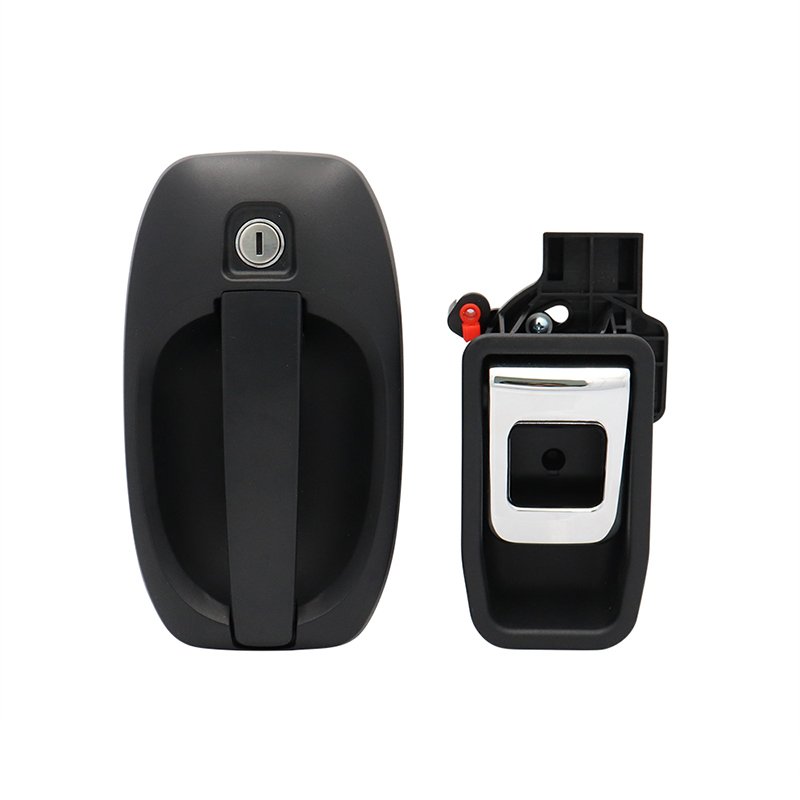
Introduction
Pry and bump attacks on RV entry doors are rarely “Hollywood” break-ins. They’re practical, low-skill methods that exploit lightweight door construction, weak anchoring, and legacy keying.
Pry attacks force the latch-side gap open until the latch bolt or deadbolt throw can slip past (or rip out) the strike pocket. On many RV doors, the limiting factor isn’t the lock body—it’s the strike plate, screws, and thin frame around it.
Bump attacks target common pin-tumbler cylinders by striking a specially cut “bump key” to momentarily align pins and rotate the plug. In the RV ecosystem, bumping is often grouped with other fast cylinder compromises like picking and drilling because the underlying risk is the same: low-security cylinders with weak physical protection.
Two procurement realities make OEM hardware vulnerable:
Light-duty locksets and anchoring are optimized for cost, not for resisting prying loads (thin skins, soft frames, short screws, minimal backing).
Common-key ecosystems (often discussed as CH751-style risk) make access control weak at scale: shared codes, keyed-alike runs across different customers, and uncontrolled key duplication.
For procurement teams, the goal is not just “buy a stronger lock.” It’s to specify, test, and document a system:
Specify door-side reinforcement (strike, backing plate, screw length, frame stiffening) alongside the lock.
Test cycle life, latch/bolt engagement, and forced-entry resistance in a way that maps to your warranty exposure.
Document compliance and traceability (certificates, material declarations, lot IDs, and defined acceptance criteria).
Attack patterns and weak points
Pry tools vs. thin skins and soft frames
A typical RV door pry attack doesn’t “defeat the cylinder.” It defeats the door structure.
Common weak points:
Strike-side spread: the door edge flexes and the jamb spreads so the bolt disengages from the strike.
Strike plate pull-out: the screws tear out because they’re short, installed into thin material, or lack a backing plate.
Cutout deformation: large lock cutouts in thin doors concentrate stress and allow the lock area to “oil-can” under load.
The relevant procurement insight is simple: when the frame yields, even a high-quality deadbolt may not hold.
Bump/pick/drill on legacy cylinders
Legacy cylinders are compromised in three predictable ways:
Lock bumping: relies on tolerances and lack of anti-bump features.
Picking: becomes easier when pins and keyways are generic and the cylinder lacks security pins/sidebars.
Drilling: succeeds when there are no hardened inserts, no cylinder shield, and no anti-drill plate protecting the line of attack.
In RV fleets and channel distribution, the impact is amplified by key management: duplicated keys, shared key codes, and uncontrolled rekey events.
Hinge, strike, and screw anchoring failures
Pry resistance is only as strong as the anchoring path:
Hinges fail when pins are removable, screws are short, or the hinge-side frame is thin and unreinforced.
Strikes fail when the strike is thin or unsupported, and when screws don’t penetrate into structural material.
Screws fail when they’re too short, too soft, or installed into low-strength substrate without a backing strategy.
If your supplier can’t describe the anchoring strategy (and how it’s verified), you don’t have a security upgrade—you have a parts swap.
Hardware upgrades to stop prying (RV door security upgrades)
Multi-point locks and Grade 1 deadbolts
For pry resistance, you want to reduce how much “give” the door has under leverage.
Two upgrades do that in different ways:
Multi-point locks distribute load across multiple engagement points (top/center/bottom), making it harder to spread the latch-side gap with a single pry point.
Higher-grade deadbolts improve the durability of the bolt mechanism and lock body under abuse.
Procurement specs to write down (and require evidence for):
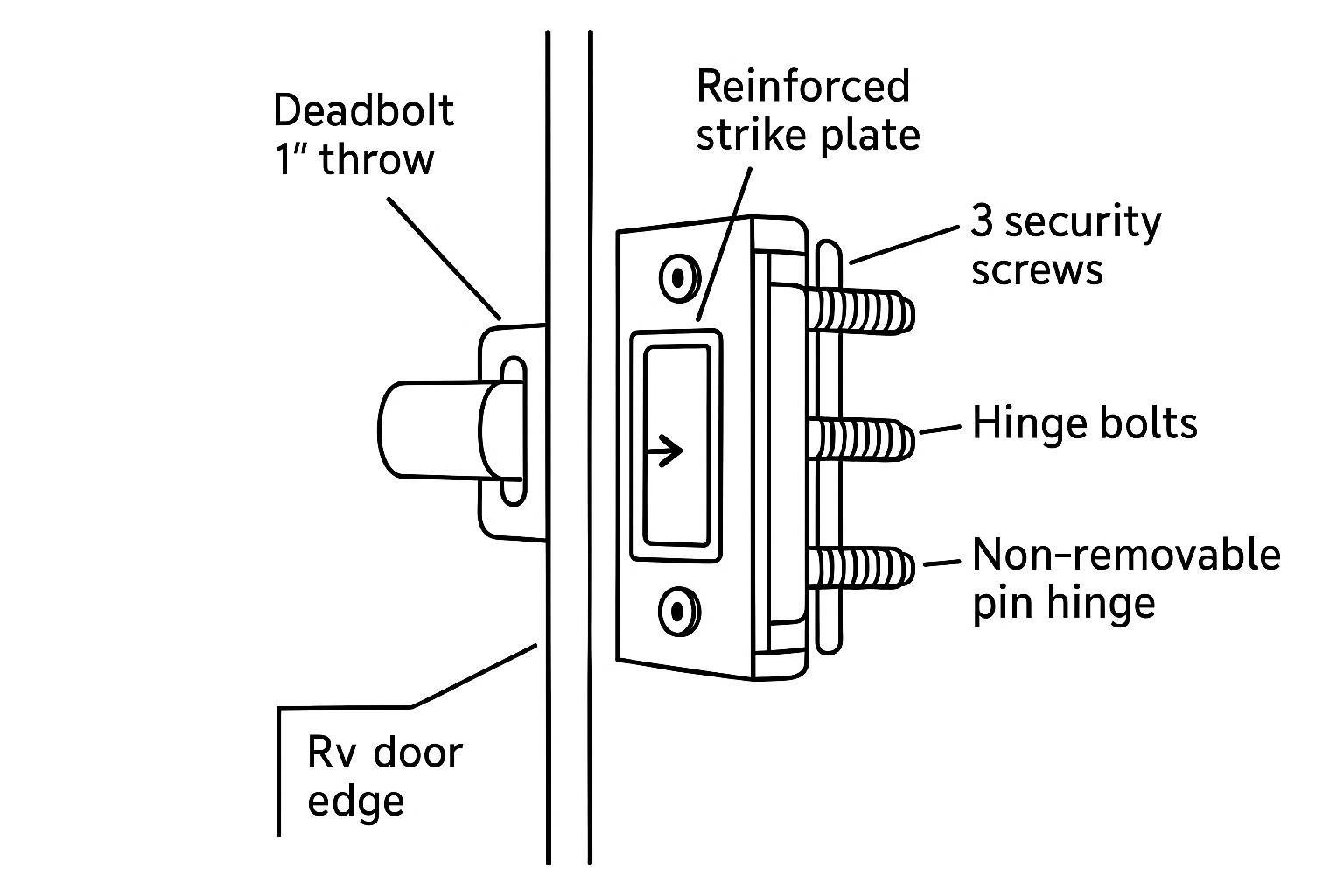
Deadbolt throw length (how far the bolt extends into the frame).
Whether the deadbolt is specified as an ANSI/BHMA Grade 1 deadbolt (or the equivalent duty level required by your program) and how that claim is verified.
Bolt and strike materials (hardened inserts, thick-gauge steel where it matters).
Cycle-life expectations and test method alignment with your warranty period.
Key Takeaway: When prying is the threat model, the “best lock” is the one that stays engaged with the frame under spreading load—and that’s primarily a strike/backing/screw problem.
Reinforced strikes and metal backing plates
A reinforced strike is not just “a thicker plate.” It’s a system:
A strike plate that resists bending.
Screws long enough to anchor into structure.
A metal backing plate (or equivalent reinforcement) that prevents screw pull-out and distributes load.
What fails if you skip this:
A pry bar turns the strike-side into a lever: the strike flexes, screws pull, the jamb spreads, and the bolt clears.
What to specify in RFQs:
Strike plate thickness/material requirements.
Backing plate material and coverage area around the strike pocket.
Minimum screw length and substrate penetration (e.g., “long screws that reach structural frame material,” not “included screws”).
Hinge security, long screws, and door frame stiffening
Hinge-side reinforcement matters for two reasons:
It prevents hinge pin/screw attacks.
It reduces overall door flex under pry load.
Procurement specifications that translate into real resistance:
Non-removable pin hinges or hinge security features (hinge bolts/pin blockers).
Long screws at hinges and strike that penetrate into structural members.
Frame stiffening strategy for thin/soft frames (reinforcement channels, backing plates, or engineered inserts).
Stop bumping, picking, and drilling
High-security cylinders, shields, and anti-drill components
If your door security relies on a keyed cylinder, treat the cylinder as a spec item—not a commodity.
Procurement requirements to consider:
Cylinder with drill resistance (hardened inserts/anti-drill features).
Cylinder shields or guarded housings that reduce direct tool access.
Higher-security cylinder standards where appropriate. For example, UL’s high-security cylinder listing is often referenced as a way to define resistance to picking, drilling, and forced-entry attacks in a repeatable test framework (see a neutral explanation of what UL 437 high-security cylinders actually test).
⚠️ Warning: Over-specifying a cylinder without reinforcing the strike and anchoring often produces a false sense of security. Attackers will simply move to the weakest mechanical link.
Rekey away from CH751 and keyed-alike risks
In channel distribution, a common operational failure is deploying shared keys across large numbers of units—then discovering that “lost keys” and “unauthorized access” are indistinguishable events.
A procurement-ready rekey policy should define:
When you allow keyed alike (KA) vs keyed different (KD).
Who can request rekey events and how they’re documented.
How you prevent uncontrolled key duplication (restricted keyways, controlled blanks, or process controls).
For RVs, CH751 is frequently referenced as a “common key” risk because it highlights the underlying issue: too many locks in the field share codes and can be opened with widely available keys. If you need a short internal primer for stakeholders, Kinntoo’s overview of the CH751 key risk and cylinder upgrade options is a useful starting point for framing why key control belongs in the RFQ.
Keyless keypad/BLE locks with lockout and audit
Keyless entry can reduce exposure to picking/bumping and eliminate a large class of key-control failures—if you specify the right behaviors.
Procurement fields to include for keypad/BLE locks:
Lockout behavior after repeated wrong codes (retry limits and lockout duration).
Credential management: how codes are created, changed, and revoked.
Mechanical override policy (who holds the override key and how it’s controlled).
Environmental robustness: define ingress protection (IP) requirements using IEC language rather than “waterproof.” The IP code is defined in IEC 60529 (IP code / Ingress Protection rating).
When positioning suppliers, keep it evidence-driven. For example, Kinntoo’s product pages describe keyless and mechanical options and provide procurement-oriented details such as keying modes (KD/KA), and on some models claims around IP rating and corrosion testing; see Kinntoo RV door locks (keyless and mechanical) and their discussion of keypad vs traditional RV locks. Treat these as inputs to your verification plan, not substitutes for it.
Install and verify RV door security
Mounting and anchoring best practices
Installation quality determines whether your “security upgrade” survives vibration, door sag, and thermal cycling.
Best practices to specify (and audit in sample builds):
Fasteners: correct grade, correct length, correct engagement into structure.
Backing strategy at lock cutouts and strikes to prevent deformation.
Alignment of bolt throw to strike pocket with adequate clearance under door sag.
Cycle, impact/force, and latch/bolt checks
Procurement teams should define acceptance tests that match real failure modes:
Cycle tests for latch and deadbolt (verify no binding as seals compress and relax).
Engagement checks (bolt fully enters strike pocket; door does not “half-latch”).
Force/impact checks focused on the strike-side anchoring path.
If you need a conceptual model of how doors fail under forced entry (separation of the lock throw from the strike), a forcible-entry reference like the forcible-entry manual on separating lock throw from strike helps frame why reinforcement focuses on the strike and surrounding structure.
Corrosion protection, IP sealing, and emergency egress
For RV hardware, corrosion and sealing are not “nice to have”—they drive failure rates.
Procurement requirements should include:
Material and coating requirements for coastal and winter-salt exposure.
IP rating targets for keypad modules and exposed electronics.
A defined emergency egress behavior (inside release) and documentation of how the lock behaves during low battery or component failure.
Standards, testing, and MX compliance
ANSI/BHMA grades, UL 437/1034/294 relevance
For RV door security upgrades, standards don’t make a lock secure by themselves, but they give you procurement language that can be tested and audited.
ANSI/BHMA grades are commonly used to describe duty level and durability expectations for locksets and deadbolts.
UL 437 is a frequently cited reference point for high-security cylinders (picking/drilling/forced-entry resistance under defined tests).
UL 1034 and UL 294 are commonly discussed in the context of electric locksets and access control systems. If you are specifying electronic locks for commercialized RV fleets or rental environments, confirm which listings are relevant to your integration and selling jurisdictions.
IEC 60529 (IP) and ASTM B117 benchmarks
Two test families often translate cleanly into RFQ language:
IEC 60529 IP ratings: Define ingress protection for dust/water with the IPxx code (e.g., what the first and second digits mean). Use IEC 60529 IP terminology rather than “waterproof.”
ASTM B117 salt spray: Use it as a baseline corrosion screening benchmark, then align hours and acceptance criteria to your selling regions and warranty exposure.
NOM/IFT certificates, RoHS/REACH, warranty and traceability
For AU/BR/MX channel procurement, documentation often matters as much as the hardware:
NOM/IFT: If your product routing includes Mexico and your lock includes wireless features (BLE), confirm the regulatory pathway and required certificates for your specific configuration.
RoHS/REACH: Require declarations and material documentation as part of the supplier quality pack.
Warranty and traceability: Define lot/batch identification, inspection records per lot, and the failure-analysis process.
A practical approach is to make documentation deliverables explicit RFQ line items, including:
certificates and declarations (as applicable)
test reports (cycle, corrosion, ingress)
drawings and cutout compatibility statements
traceability format (labeling, batch IDs)
warranty terms, exclusions, and RMA workflow
Conclusion
A prioritized upgrade path for procurement is:
Stop prying first: reinforced strike + backing + long screws + frame stiffening strategy.
Then harden the locking system: multipoint or higher-grade deadbolt where compatible.
Then close cylinder vulnerabilities: specify higher-security cylinders and shields; formalize rekey and key-control policy away from common-key risk.
Then validate keyless where it fits the SKU strategy: lockout behavior, credential lifecycle, sealing and corrosion requirements.
RFQ field checklist (copy/paste starter):
Lock type: single-point / multipoint; deadbolt throw length
Strike plate: material/thickness; backing plate requirement
Fasteners: minimum length; required penetration into structure
Hinge security: non-removable pin / hinge bolts; screw length
Cylinder: security level, drill resistance, shield requirement; key control policy
Environmental: target IP rating per IEC 60529; corrosion test baseline per ASTM B117
Verification: cycle test method; engagement checks; force/impact test description
Compliance pack: NOM/IFT (if applicable), RoHS/REACH declarations, warranty, traceability format
Next steps: if you want a supplier-ready spec pack (drawings checklist + acceptance test sheet + documentation list) aligned to your cutout and door thickness, start from Kinntoo’s OEM overview at Kinntoo RV lock wholesale and OEM options and request the matching drawings and compliance documents for your target SKUs.
FAQ
What’s the single most effective upgrade to stop RV door pry attacks?
In most real-world pry events, the door and frame fail before the lock body does. The fastest, highest-impact upgrade is a reinforced strike + proper backing plate + long screws that bite into structural material. This reduces jamb spread and screw pull-out so the bolt stays engaged when the latch-side gap is forced.
Are “high-security cylinders” enough to stop bumping and picking on RV locks?
They help—but only as part of a system. A higher-security cylinder (plus shields and anti-drill features) can reduce bumping/picking/drilling risk, but attackers often switch to prying if the strike and frame are weak. Pair cylinder upgrades with strike reinforcement, verified bolt engagement, and a defined key-control policy.
How should fleets handle keyed-alike versus keyed-different to reduce unauthorized access?
Use keyed different (KD) as the default for units where access control matters (rentals, service fleets, high-value rigs). Allow keyed alike (KA) only when there’s a clear operational reason—and document it. Add process controls such as authorized rekey requests, tracking who holds override keys, and limiting uncontrolled duplication (restricted keyways or controlled blanks).
