
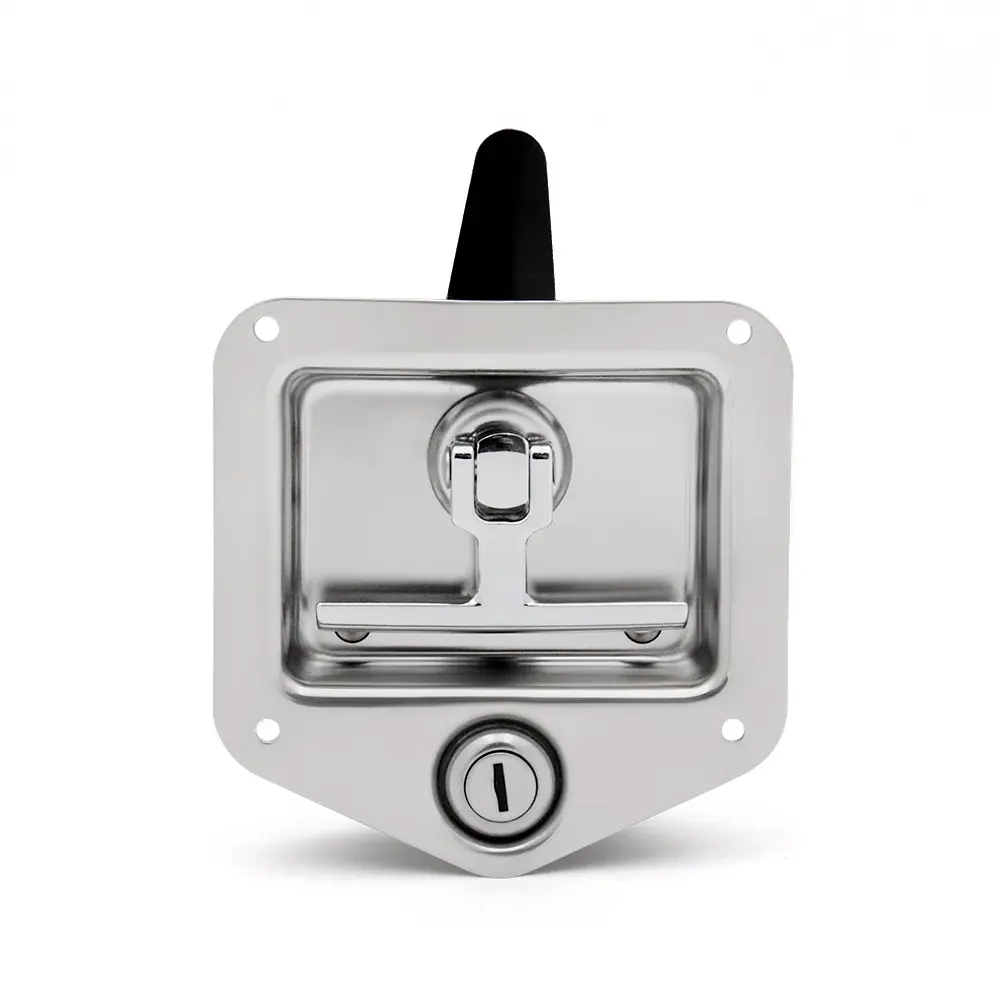
Introduction
This guide is for RV aftermarket distributors and channel procurement teams who have to make stocking decisions that hold up in the real world: mixed door cutouts, multiple OEM eras, variable installer skill, and a return pipeline that gets expensive fast.
For this audience, an RV door lock is not a “nice-to-have” accessory. It’s a fitment-sensitive item where small spec mismatches create big costs: restocking fees, reverse logistics, install labor disputes, and warranty noise that eats margin.
An RV paddle deadbolt solves a different problem than latch-only locks. A spring latch is about keeping a door closed during travel and normal use. A deadbolt is about resisting forced entry when the occupant isn’t actively holding the handle.
To evaluate specs quickly (and prevent the most common returns), focus on four items up front: dimensions, materials, cycle life, and documentation/compliance. You should be able to scan a drawing and a short spec sheet and decide whether a lock belongs on your shelf.
If you need a deeper fitment walk-through and QC checks, Kinntoorvlock.com also publishes RV Paddle Deadbolt: Benefits, Fitment, and QC Guide.
RV paddle deadbolt security
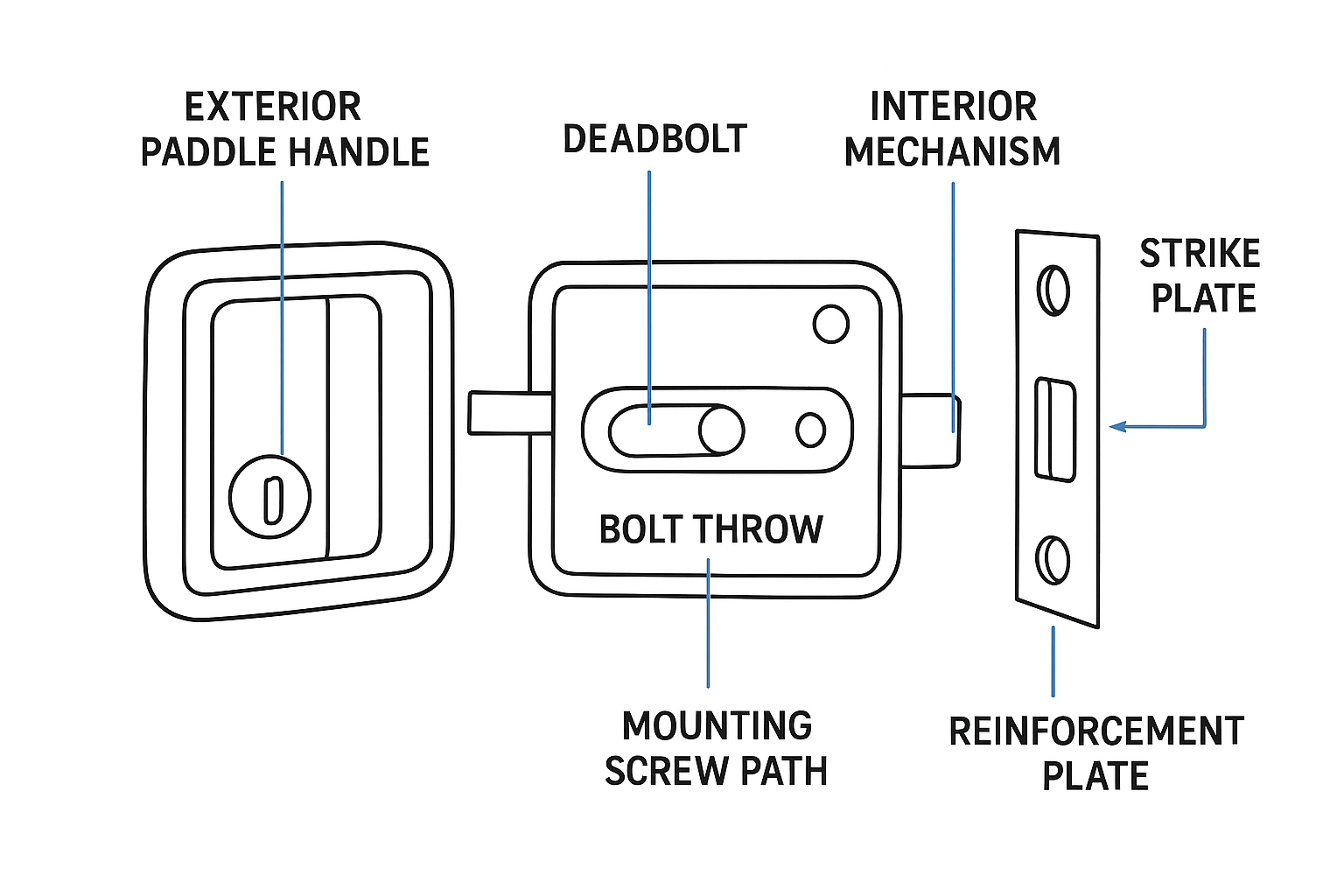
Integrated deadbolt mechanics
Paddle-handle RV locks usually combine two functions:
Spring latch (paddle-operated) for day-to-day entry.
Deadbolt that throws a solid bolt into the frame-side strike.
For distributors, the important point isn’t marketing language about “high security.” It’s the mechanical separation of functions. A latch-only lock can be forced by attacking the latch area. A deadbolt adds a second engagement point that (when properly installed) demands a different attack and more time.
When you review a lockset, look for clear documentation on:
Bolt travel (bolt “throw”) and how it engages the strike
How the deadbolt is driven (key cylinder / interior turn / combined mechanism)
How the latch and deadbolt interact (or don’t)
Anti-pry design and reinforcement
Forced-entry resistance in this category is usually less about the cylinder and more about the frame-side hardware and how loads transfer into the door structure.
In practice, distributors see two common field failures that look like “security issues” but are actually installation/spec issues:
Weak strike anchoring: short screws into thin jamb material, no reinforcement plate, misaligned strike.
Door skin deformation: the lock compresses or crushes soft door construction over time, creating play.
For stocking decisions, treat reinforcement compatibility as a must-have spec. That means you want:
A strike plate design that can be anchored into structure (not just trim)
A reinforcement/stiffener option (or clear guidance to use one)
Hardware that supports correct screw length and bite without cracking the frame material
Materials, corrosion, cycle life
Exterior RV door hardware lives in sun, rain, road salt mist, and temperature swings. For distributors serving Australia, coastal Brazil, and many US/Canada regions, corrosion performance is not theoretical.
Stocking decisions should prioritize materials and finish systems that match the environment and duty cycle:
Base materials: specify what is actually used for the handle, housing, bolt, and key cylinder components.
Corrosion guidance: ask for test method references when available (don’t accept “rustproof” claims).
Cycle life: request a stated cycle test target for both latch and deadbolt (and whether it’s tested as an assembly).
If you’re evaluating the RV Compression Latch Large Black -2970 lock (or using it as a benchmark SKU), ask the supplier to document the following verification tests as part of the QC pack:
Cross-hatch adhesion test (2970): verifies coating/paint adhesion after a cross-hatch cut and tape pull.
High & low temperature test: checks whether the lock becomes brittle or cracks after exposure to 70°C heat and -30°C cold.
Neutral salt spray test: checks for visible rust or corrosion after salt spray exposure.
Waterproof test (2 hours): checks whether the 2970 lock shows any leakage during a 2-hour water exposure.
If a supplier can’t provide basic material callouts and a simple test narrative like the above, you should assume higher variance in the field and price that risk into your TCO.
Installation and compatibility
Standard cutouts and thicknesses
Most return issues happen here.
Across common retail listings, a widely used paddle entry deadbolt format calls out a 2-3/4″ × 3-3/4″ door cutout and a 1-1/4″ to 1-1/2″ door thickness range. As one published example, RecPro lists these dimensions on its RV Paddle Entry Door Lock Latch with Deadbolt. FactoryRV also lists a 2-3/4″ × 3-3/4″ cutout for a paddle entry deadbolt lock on its RV Door Lock | Paddle Entry with Deadbolt.
Those numbers are useful as a stocking baseline, not as a promise. The distributor-safe approach is:
Use common cutouts to guide SKU coverage.
Require customers and installers to verify against the lock’s drawing before ordering.
⚠️ Warning: “Universal fit” language is one of the biggest drivers of returns in this category. The cutout may match, but deadbolt position, interior clearance, and screen-door spacing can still fail.
Drop-in replacement guidance
A true drop-in replacement is more than “same cutout.” It usually means the replacement:
Matches cutout and door thickness
Aligns with the existing strike location (or includes a strike that can be relocated cleanly)
Clears interior trim and exterior screen doors
Door thickness is a repeat offender. RVLock’s help desk notes that 1-1/2″ is a common standard for RV entry doors and that spacers may be required when doors are thinner than the lock is built for (see RVLock’s “What If My Entry Door Is Too Thin?” note).
From a distributor standpoint, this drives two practical policies:
Stock (or bundle) spacers and reinforcement parts where your chosen product line supports them.
Make door thickness a required field in your RFQ/order checklist.
Weather sealing and testing
Weather sealing is where installs “look fine” on day one and fail later.
Distributor-facing best practice is to treat sealing as a simple verification routine, not a hope:
Confirm gasket compression is even (no gaps at corners)
Confirm the latch and deadbolt operate smoothly without binding (binding is often a sign of misalignment that will worsen)
Confirm the strike-side engagement is clean with the door slightly pushed/pulled (to simulate real use)
This is also where consistent supplier documentation matters: clear torque guidance, gasket replacement availability, and installation notes reduce your downstream support burden.
Procurement, compliance, TCO
Keyed-alike and SKU strategy
Distributors end up supporting mixed fleets: rental operators, service networks, and multi-door RV configurations (entry door plus compartments). Key management becomes a supply-chain problem.
A pragmatic keyed-alike strategy can reduce SKUs and reduce customer friction, but it has to be planned:
Define which lock families can be keyed alike (entry vs compartments may not share cylinders)
Define a controlled key code strategy to avoid “accidental keyed alike” overlaps
Keep a clean separation between “consumer convenience keys” and “fleet/service keys”
If your customers are still using widely shared key codes on non-entry compartments, it’s worth framing the risk clearly and offering an upgrade path. Kinntoorvlock.com’s breakdown of common RV key systems in CH751 vs Tubular vs Laser‑Engraved vs Keyless Locks: Pros and Cons can help procurement teams explain key-control tradeoffs internally.
Documentation and compliance
For AU/BR/MX and US/Canada distribution, “compliance” often means two different things:
Channel documentation (what your customers require to list and sell the item)
Cross-border paperwork (what helps shipments move without avoidable holds)
At minimum, your supplier should be able to provide a clean document pack on request:
Dimension drawing (cutout, backset, door thickness range, strike dimensions)
Materials declaration and finish description
Installation instructions and parts list
Warranty terms and claims process
Environmental declarations commonly requested by channels (e.g., RoHS/REACH statements when applicable)
Don’t accept a “trust us” answer here. Missing docs are a predictable source of delays, not an edge case.
Costs, warranty, RFQ tips
Here’s the distributor lens on TCO: the lock cost is often smaller than the cost of one preventable return.
Use a short RFQ checklist to force clarity before you quote or stock.
RFQ / Stocking checklist item | Why it matters | Required from supplier? |
|---|---|---|
Cutout size(s) supported (e.g., 2-3/4″ × 3-3/4″) | Prevents the most common wrong-order returns | Yes |
Door thickness range + spacer options | Avoids “almost fits” installs | Yes |
Handing and door/screen clearance notes | Avoids on-site surprises | Yes |
Materials + finish callouts | Predicts corrosion risk and warranty noise | Yes |
Cycle-life test statement (method + target) | Screens out low-durability builds | Preferred |
Coating adhesion test result (cross-hatch) | Reduces peeling/finish complaints and premature corrosion exposure | Preferred |
High/low temperature brittleness check | Screens for cracking risk in storage and seasonal climates | Preferred |
Salt spray test record (neutral) | Helps benchmark corrosion resistance across suppliers | Preferred |
Waterproof test record (2 hours) | Reduces leak-related returns and “it failed after rain” claims | Preferred |
Strike/reinforcement guidance | Predicts forced-entry resistance and long-term alignment | Yes |
Warranty length + claim workflow | Sets expectations and reduces disputes | Yes |
Keying options (keyed unique / keyed alike) | Controls SKU count and key management | Yes |
Packaging and spare parts availability | Helps service networks and reduces returns | Preferred |
If you also sell replacement handles, keep a compatibility reference ready. Kinntoorvlock.com’s RV door handle types and compatibility guide is a useful model for how to present fitment in a way that reduces back-and-forth.
Conclusion
Distributors win in this category by treating RV paddle deadbolts as a spec-driven product, not a generic hardware item. The payoff is concrete: faster installs, fewer returns, and tighter SKU coverage with less key-management chaos.
Use this action checklist when you build an RFQ or decide what to stock:
Sizes: cutout, door thickness range, strike dimensions
Materials: base materials and finish system for your climate mix
Tests: cycle-life statement and any corrosion narrative you can verify
Warranty: term, claim process, and spare-parts support
Key strategy: keyed-alike policy and key-control approach
For stocking, start with dominant cutouts and door thickness ranges in your channel, then add variants only when you can support them with drawings and a clear compatibility policy.
If your team needs a spec pack to speed RFQs (drawings, compatibility fields, and a distributor checklist), Kinntoorvlock.com can support that request through its product and documentation pages, starting at RV Door Locks.
FAQ
What’s the difference between an RV paddle lock and an RV paddle deadbolt?
An RV paddle lock typically includes a spring latch operated by the paddle handle. An RV paddle deadbolt adds a second, solid bolt that throws into the strike for better forced-entry resistance. For distributors, the difference shows up in fewer “it feels flimsy” complaints and a clearer spec conversation: latch function vs deadbolt function.
What measurements should customers confirm before ordering an RV paddle entry door lock with deadbolt?
At minimum, confirm the door cutout, door thickness, strike location/bolt alignment, and any screen-door/interior trim clearance. Even when a listing claims a common cutout (like 2-3/4″ × 3-3/4″), deadbolt position and interior clearance can still cause a non-fit and a return.
What durability tests are worth requesting for RV entry door locks?
Ask for a simple, documented test pack that matches real field failure modes: coating adhesion (cross-hatch), high/low temperature brittleness, neutral salt spray for corrosion, and a waterproof/leak check (for example, a 2-hour water exposure test). These don’t guarantee “no failures,” but they make supplier comparisons more objective and help you set RFQ expectations.
