
Introduction
If you’re a wholesaler or an OEM sourcing lock cores for RV compartments and industrial enclosures, the lock choice is rarely just “what fits the cutout.” It’s a bundle decision across:
- security (what an attacker can realistically do)
- key control (who can get copies, and how fast)
- environment (dust, road spray, coastal salt, UV)
- serviceability (spares, rekeying, field replacement)
- total cost of ownership (returns, warranty, downtime, and rework)
This comparison covers four common options you’ll see in RFQs:
- CH751 wafer cam locks (common “universal” RV baggage locks)
- tubular cam locks
- laser‑engraved / dimple cylinders (higher key-control potential)
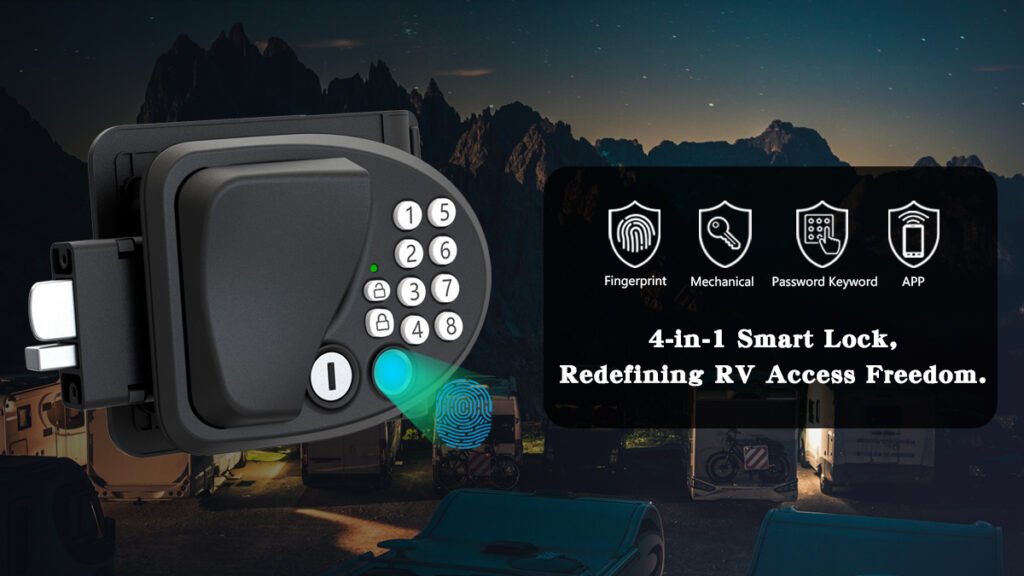
- keyless electronic cam locks / keyless RV locks
Outcome: by the end, you should be able to define RFQ specs, set a keying strategy (KA/KD/master), and document upgrade paths by risk and use case.
Mechanical pros and cons
CH751 wafer locks
Where they fit
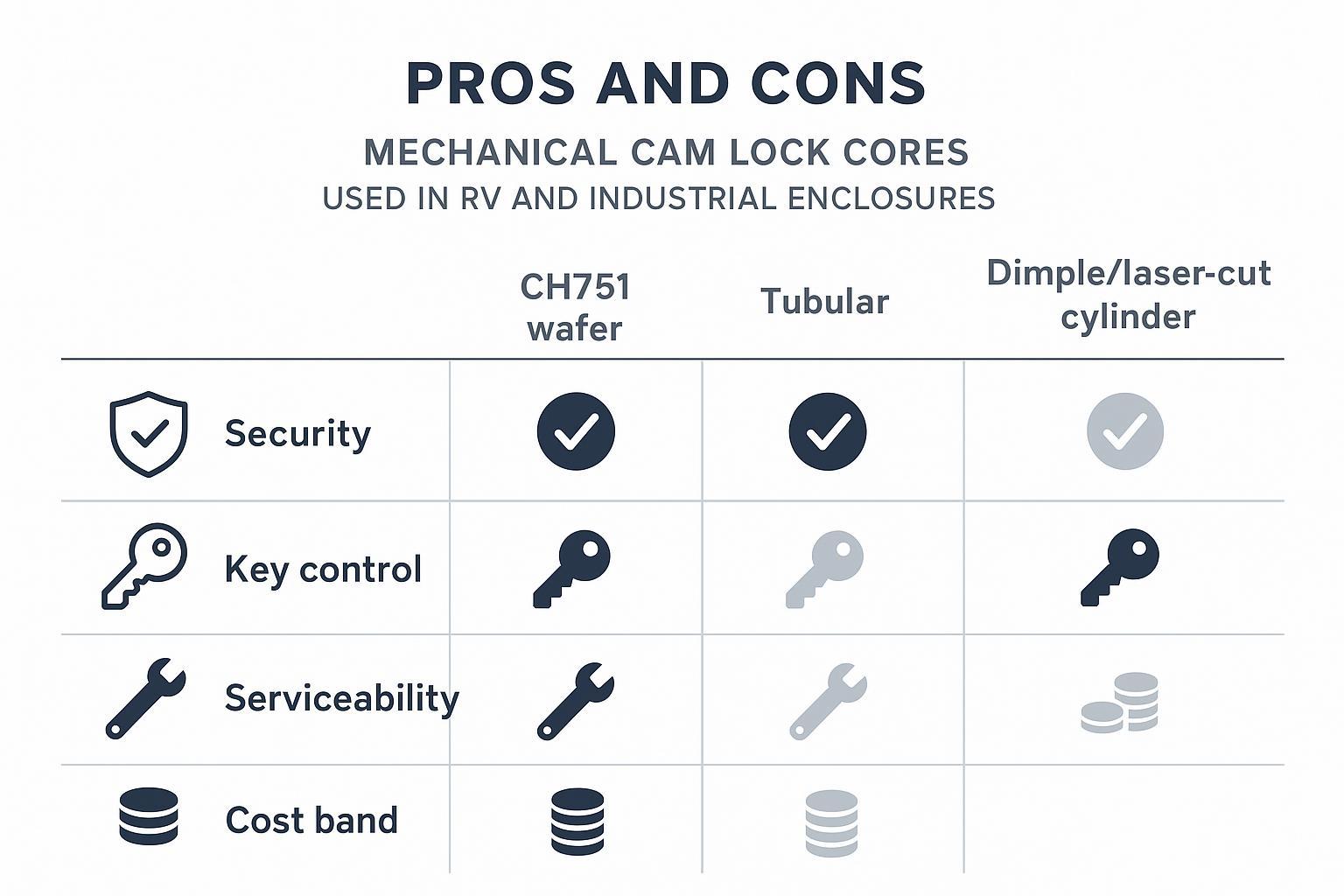
CH751 is best treated as a convenience access solution for low-risk compartments. In the RV aftermarket, it’s widely discussed as a shared / “universal” key code used across many compartment cam locks, which creates obvious access-control limits if the compartment contains valuables or safety-critical items.
Pros
- Lowest unit cost and broad availability across common RV compartment footprints.
- Fast to service: cylinders and keys are easy to source and swap.
- Simple training burden for end users and service techs.
Cons
- Weak key control by design: because the key code is widely available, it’s difficult to manage who can obtain a working key. In practice, this increases the chance of unauthorized access compared with a keyed-different or restricted-keyway system. RV-focused warnings about “most compartments using the same key” are common in the field (for one example, see The Fun Times Guide’s CH751 overview).
- Security depends on the enclosure: thin doors, exposed fasteners, and weak cam retention often fail before the lock core does.
- Upgrade pressure later: when unauthorized access becomes a warranty or brand issue, you’ll spend time and money migrating customers to a more controlled key system.
Practical procurement takeaway: if you spec CH751, treat it explicitly as a low-security choice and manage expectations accordingly in product positioning and warranty language.
Tubular cam locks
Where they fit
Tubular cam locks are a common middle step: still compact and serviceable, typically stronger against casual manipulation than basic wafer locks, and often perceived as “more secure” by customers.
A quick terminology note for RFQs: “tubular key” is a keyway format used on tubular cam locks (i.e., it’s still within the cam-lock family). It’s not just an “older” product category—tubular cam locks are still widely used today, and real-world performance depends heavily on cylinder design, tolerances, and how you manage key control.
This is the common real-world comparison buyers make: tubular cam lock vs wafer cam lock. The biggest difference is not the key shape; it’s whether you pair the lock with a workable key-control plan.
Pros
- Better resistance to casual picking than many basic wafer cam locks (still not “high security” by default).
- Good ergonomics for frequent access: easy insertion and operation.
- Wide fitment across cabinet and enclosure applications.
Cons
- Security varies by tolerances and design: low-cost tubular cylinders can be vulnerable to specialized tools.
- Key control is usually limited unless you pair the format with a controlled keyway program.
- Still exposed to the “enclosure-first” reality: if the cam can be reached or the panel flexes, the lock type matters less.
Practical procurement takeaway: specify tubular locks with a defined quality level (tolerance class, corrosion requirements, cycle-life expectation), and don’t skip the key-control plan just because the keyway looks “special.”
Laser‑engraved/dimple cylinders
“Laser‑engraved” gets used loosely in sourcing conversations. Two clarifications help prevent spec drift:
- “Laser‑engraved / computer‑cut key” usually describes the cutting method, not a guaranteed cylinder security level.
- Key material isn’t automatically “all copper/brass.” Depending on supplier and spec, keys may be brass, nickel silver, steel, or plated variants.
What matters for buyers is the system: a cylinder design that supports more meaningful key control (restricted keyways, managed duplication) and typically stronger resistance to casual manipulation than commodity cam locks.
In practical terms, you’re choosing a dimple lock cylinder (often with a more complex key profile) and then deciding whether the keyway is restricted.
Pros
- Best key-control potential when paired with a restricted/patented keyway program.
- Good fit for higher-risk compartments: fleet/RV rental operations, high-value cargo compartments, or industrial panels where unauthorized access creates liability.
- Clear upgrade path: you can migrate customers from “universal key” to controlled keying without moving to electronics.
Cons
- Higher component cost and typically longer lead times (especially for restricted key systems).
- Service complexity: if spares aren’t planned, field support suffers.
- Not automatically high security: “laser‑cut” or “dimple key” alone is not a guarantee—specs (restricted keyway policy, cylinder design, tolerances) and supplier quality matter.
Keyless systems: features and trade‑offs
Keyless lock systems range from simple mechanical combination cam locks (no battery) to electronic keypad/Bluetooth RV door locks and industrial electronic latches with monitoring.
Access and administration
Where keyless wins
- Multi-user access without issuing physical keys (useful for rental fleets, service networks, and multi-warehouse operations).
- Lower “lost key” friction and fewer urgent shipments of replacement keys.
- Depending on the platform, you may get features like remote credential management or activity logs.
Where it gets hard
- Admin policy is now part of the product: code rotation, credential resets, and who is authorized to override.
- Training and documentation become procurement deliverables (not optional).
A practical way to set feature expectations is to compare how mainstream electronic RV door lock brands position security, usability, and backup access; Kinntoo summarizes evaluation criteria here: electronic RV door lock comparison guide.
Power, sealing, and override
Keyless choices create three RFQ questions:
- Power: battery type, expected life, low-battery behavior, and replacement procedure.
- Sealing: what’s the actual ingress protection target, and is it for the lock itself or the full door assembly?
- Override: what happens when the battery is dead or electronics fail?
Your buyers will ask for backup access. Many keyless RV lock systems retain a mechanical key or other override path; specify this explicitly so it’s consistent across SKUs.
Suitable applications
- High-frequency access, moderate risk: keyless can reduce operating cost if access events are frequent and key loss is common.
- High-risk compartments: keyless can be strong if the platform has solid materials, real sealing, and a credible override strategy.
- Harsh environments: electronics can perform well, but only if sealing, corrosion resistance, and battery behavior are specified and tested.
Security and key control
Attack resistance in practice
For procurement teams, “security” is less about marketing language and more about what fails first:
- Key control failure (too many people can obtain a working key)
- Manipulation (picking/try-out keys) against low-tolerance cores
- Forced entry against thin doors and weak cam retention
CH751 is widely criticized because it behaves like a shared-key ecosystem; that’s a key-control failure, not a metallurgy problem.
Keying and key control strategies
Instead of picking a lock type first, start with a keying policy:
- Keyed-alike (KA): one key for multiple compartments. Good for end-user convenience; raises the blast radius if a key is copied.
- Keyed-different (KD): each lock unique. Better control; higher service overhead.
- Master key systems: reduces key count for service teams, but requires strict issuance control.
- Restricted keyway program: the practical way to reduce unauthorized duplication. “Do Not Duplicate” markings alone don’t reliably prevent copying; restricted systems do (see a restricted keyway explainer).
A clean RFQ will specify which of these is required, plus spares and documentation.
Serviceability and spares planning
Serviceability is where good procurement work pays for itself.
Plan for:
- spare cylinders/cores per 1,000 units (field replacement rate varies by environment)
- key blanks, controlled-key ordering process, and lead time commitments
- compatibility notes: door thickness, cam length, clockwise/counterclockwise rotation
- rekeying policy: who is allowed to rekey, and what records must be kept
If you’re migrating away from CH751, document the upgrade path clearly (what keeps the same cutout, what changes, and what happens to existing key sets). For channel teams, Kinntoo’s explainer can be used as an internal training reference: CH751 lock security risk and better RV lock alternatives.
Environment and durability
Materials and finishes
For RV and industrial enclosures, corrosion and wear are usually the cost drivers. Your lock spec should call out:
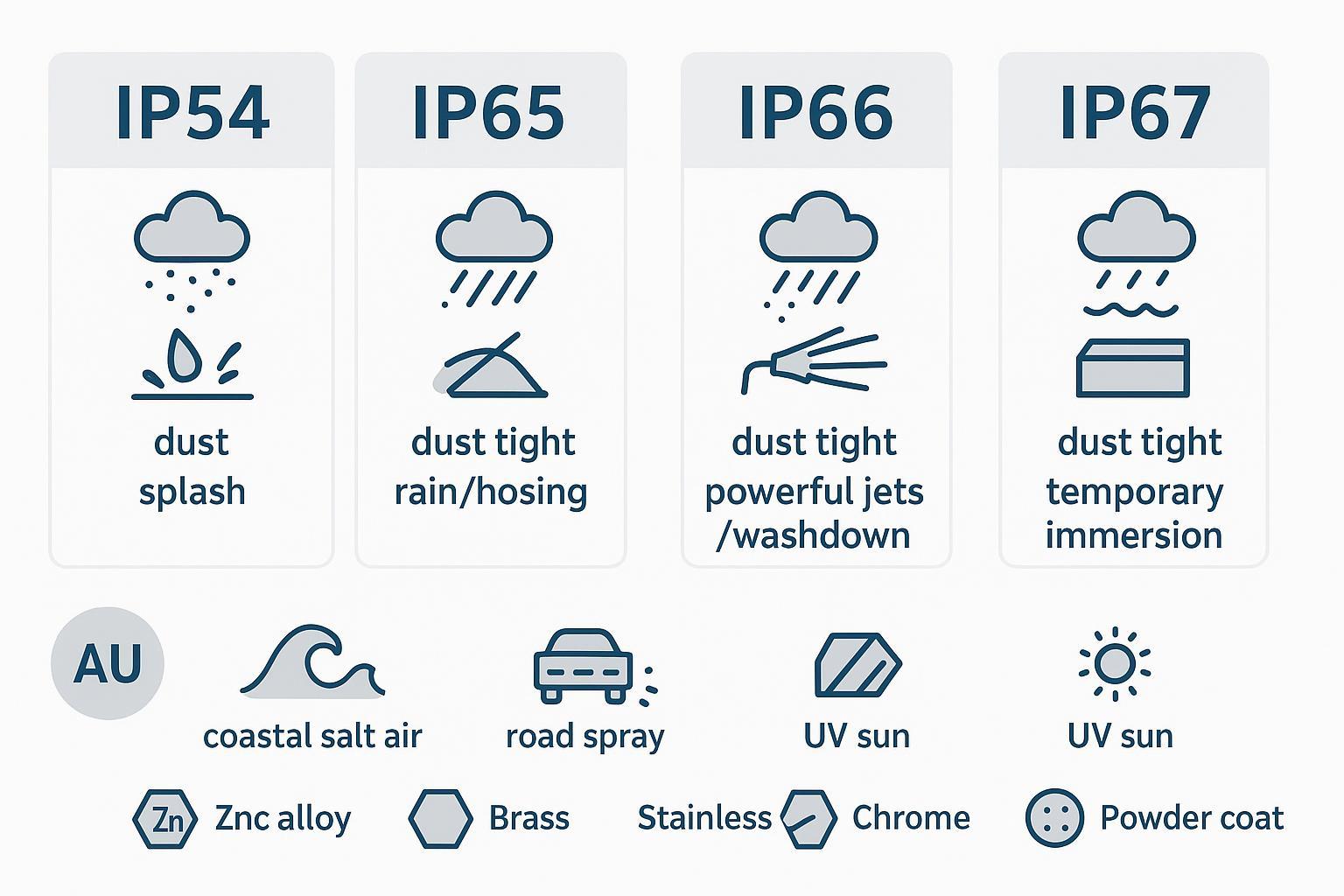
- body material (e.g., zinc alloy, brass, stainless)
- cam material and heat treatment (where relevant)
- surface finish (chrome, powder coat, etc.)
- UV exposure expectations (external RV compartments see significant sun)
IP ratings and temperature
Don’t use “waterproof” loosely. Use a target ingress protection class and state what it means.
IP ratings are defined under IEC 60529; the first digit indicates protection against solids/dust and the second against water. Two reputable explainers that explicitly reference IEC 60529 are Intertek’s Ingress Protection (IP) testing overview and Videojet’s IP ratings guide.
At a practical level:
- IP54: dust-protected + splash resistant
- IP65: dust-tight + water jets
- IP66: dust-tight + powerful water jets
- IP67: dust-tight + temporary immersion
If your buyers are debating IP65 vs IP67 lock sealing, the simplest rule is: IP65 targets hose spray and rain; IP67 is about temporary immersion. Choose based on the most plausible failure mode (road spray vs flooding/wash-down vs immersion).
Also specify temperature range for the end market. For AU conditions, the “hot car / sun-baked door” scenario matters as much as rain.
Corrosion and cycle life
For channel procurement, the biggest hidden cost is often inconsistent durability between sample and mass production.
Ask for:
- cycle test method + cycles passed (and what constitutes failure)
- salt spray duration and standard (if available)
- any vibration test conditions (important for RV road loads)
Procurement and TCO
Cost bands and lead times
A useful way to set expectations for buyers:
- CH751 wafer: lowest cost, shortest lead times, weakest key control.
- Tubular: moderate cost, moderate lead times, moderate security if quality is controlled.
- Dimple/laser-cut + restricted keyway: higher cost and longer lead time, strongest key-control upside.
- Keyless: higher BOM cost + ongoing ops cost (batteries/admin), but can reduce key-management overhead.
For distributors, the key question is not unit price—it’s returns + warranty cost when locks fail in the field.
RFQ checklist essentials
For an RFQ that prevents spec drift, include:
- door thickness range + cutout drawing
- cam length + rotation direction + retention method
- keying: KA/KD/master + key-control requirement (restricted or not)
- environment: target IP rating + corrosion requirements + UV exposure
- materials/finish requirements
- cycle life target + test method
- service requirements: spare parts, cylinder replacement method, lead times for spares
- packaging/labeling (SKU traceability matters for long-tail distributor catalogs)
To align your RFQ language to actual product families (cam locks, compression latches, door locks, etc.), reference the catalog taxonomy: Kinntoo RV locks product catalog.
Compliance and warranty terms
Channel buyers will usually need compliance docs and clear warranty boundaries:
- RoHS/REACH declarations (and any supporting test reports)
- quality system evidence (e.g., ISO certifications)
- warranty period + definition of failure + claim workflow
- required installation conditions (to avoid field blame-shifting)
Conclusion
Match lock type to risk, access frequency, and key control needs.
- CH751 is cost-effective for low-risk compartments, but structurally weak on key control.
- Tubular is a pragmatic mid-tier option when quality and serviceability are controlled.
- Dimple/laser-cut systems earn their cost when you need restricted duplication and cleaner key governance.
- Keyless is best when operational access needs justify battery/admin complexity.
If you’re planning an RV compartment lock upgrade from CH751, start by locking down the keying strategy (KA/KD/master + restricted or not), then confirm cutout compatibility and spares so the field transition is predictable.
Align materials, finish, and IP targets to the real environment; document service and spares so distributors aren’t forced into ad-hoc field fixes.
Plan commercial terms early: MOQ, lead time, Incoterms, and compliance (RoHS/REACH) should be explicit in the RFQ.
FAQ
Is CH751 a universal key?
CH751 is widely treated as a shared, “universal” key code across many RV baggage and compartment cam locks. From a procurement standpoint, that means key control is inherently weak unless you move to keyed-different, master-keyed, or restricted-keyway programs.
Are tubular cam locks more secure than wafer cam locks?
Often yes against casual manipulation, but it depends on the cylinder design and tolerances. The bigger differentiator is still keying policy (KA vs KD) and whether you have a controlled keyway program.
What’s the difference between a tubular key and a cam lock?
A tubular key is one keyway format used by tubular cam locks—so it’s part of the cam-lock category, not a separate lock family. When quoting, specify the cam-lock footprint plus the keyway format and quality level.
Are “laser‑engraved” or “computer‑cut” keys always brass or “all copper”?
No. “Laser‑engraved / computer‑cut” usually describes how the key is cut, and the key material can vary (brass, nickel silver, steel, plated variants) depending on the supplier and spec.
Do laser‑cut or dimple keys automatically prevent theft?
Not by themselves. The strongest improvement usually comes from a restricted (and well-managed) keyway program, plus a cylinder designed for higher manipulation resistance, and an enclosure/cam setup that doesn’t fail first under force.
